COMING SOON — ordering opens when CPT pricing is published. Explore the module below; the request form is open for preview.
COMING SOON
CPT Analysis Report
Upload the raw file from any CPT rig, or the report you already have, and get The Complete CPT Soil Report the same day.
Raw cone data goes in. Out comes a fully interpreted, fully cited soil report for every sounding — and, with two or more soundings, a site report with fence diagram and 3D models.
Standard delivery is 24 hours. Pricing will be published at launch.
Accepted inputs
- HT / Hogentogler .cpt and .dat raw sounding files
- Vertek / Coneplot .cor exports
- CSV with a units row · Excel with unit-labelled headers
- CPeT-IT exports (.xls)
- CPeT-IT or other PDF reports — readings recovered from the plot vectors
- GEF (Dutch standard)
One file per sounding, or one multi-sounding PDF. Units are read from the file — never guessed.
How it works
Built to be checked, not just read
CITED
Every number traced to its source
Each parameter is cited to the paper it came from. Only the formulas actually used are printed.
TWO CHAINS
Robertson and Mayne, side by side
Two independent correlation chains are printed next to each other. Nothing is averaged silently.
45 CHECKS
Printed in full, per sounding
Forty-five automated checks run on every sounding and print in full. A blocking failure returns a stop notice instead of a report.
PDF IN
Reads the report you already have
CPeT-IT PDFs are read by recovering the readings from the plot vectors, not by tracing pictures.
HANDOFF
One field program, two reports
The layer model is handed straight to the RAMP helical engine, so a helical pile design can follow from the same data.
SITE
Site package adds the 3D picture
Fence diagram, 3D block model, layered topographic 3D model and one sheet per sounding, with the governing design profile.
Packages
Pick what the project needs
Prices will be published when ordering opens.
Soil report per sounding
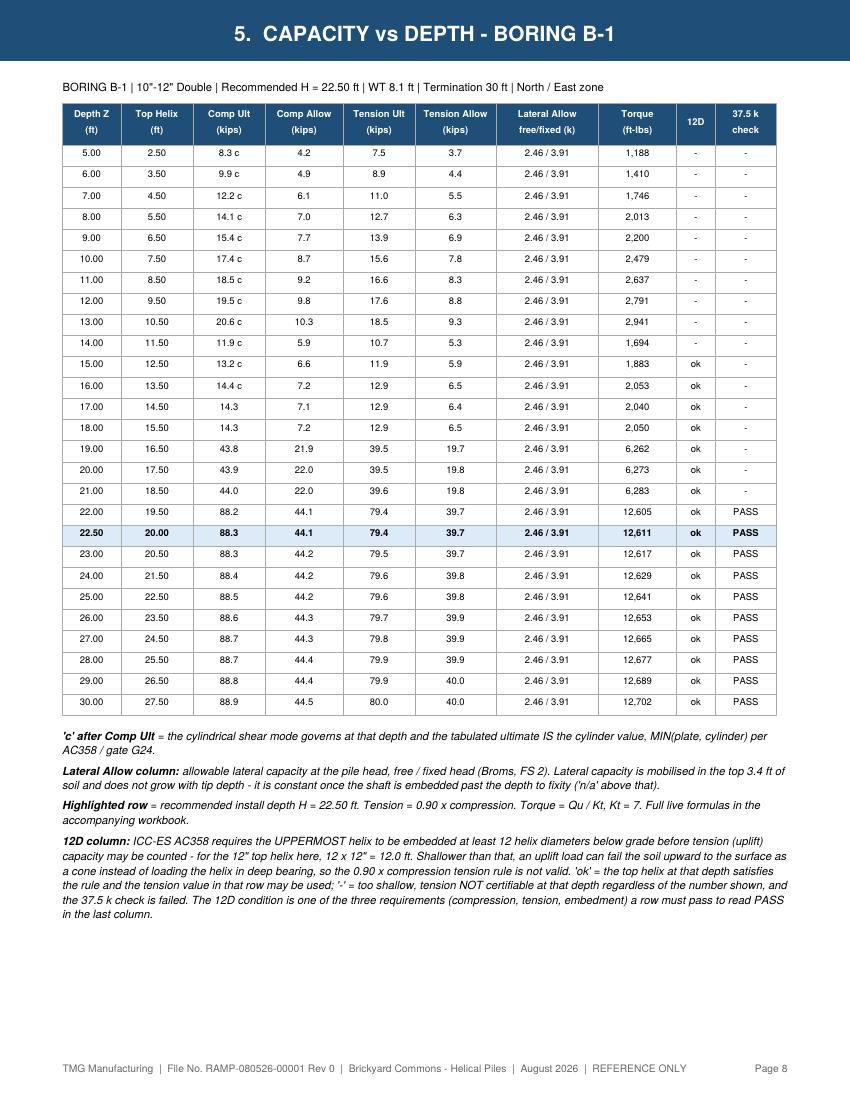
The Complete CPT Soil Report, 21 to 24 pages: profiles, SBT charts, layers, design parameters, strength, stiffness, N60 cross-check, site class, foundation screening, formulas, 45-check manifest, CSV and layer JSON.
Price at launch
Site package
Two or more soundings. Everything above for each sounding, plus the site report: fence diagram, 3D block model, layered topographic model, sounding sheets, lateral variability, governing design profile, site JSON.
Price at launch
Second opinion
Upload the CPT report you already have. We recover the readings from its plots and re-interpret with two independent correlation chains, side by side with the original.
Price at launch
Seismic site class & liquefaction
Vs profile, ASCE 7-22 site class, liquefaction factor of safety and LPI for your design earthquake. Short-form report.
Price at launch
Add-ons
Helical design handoff
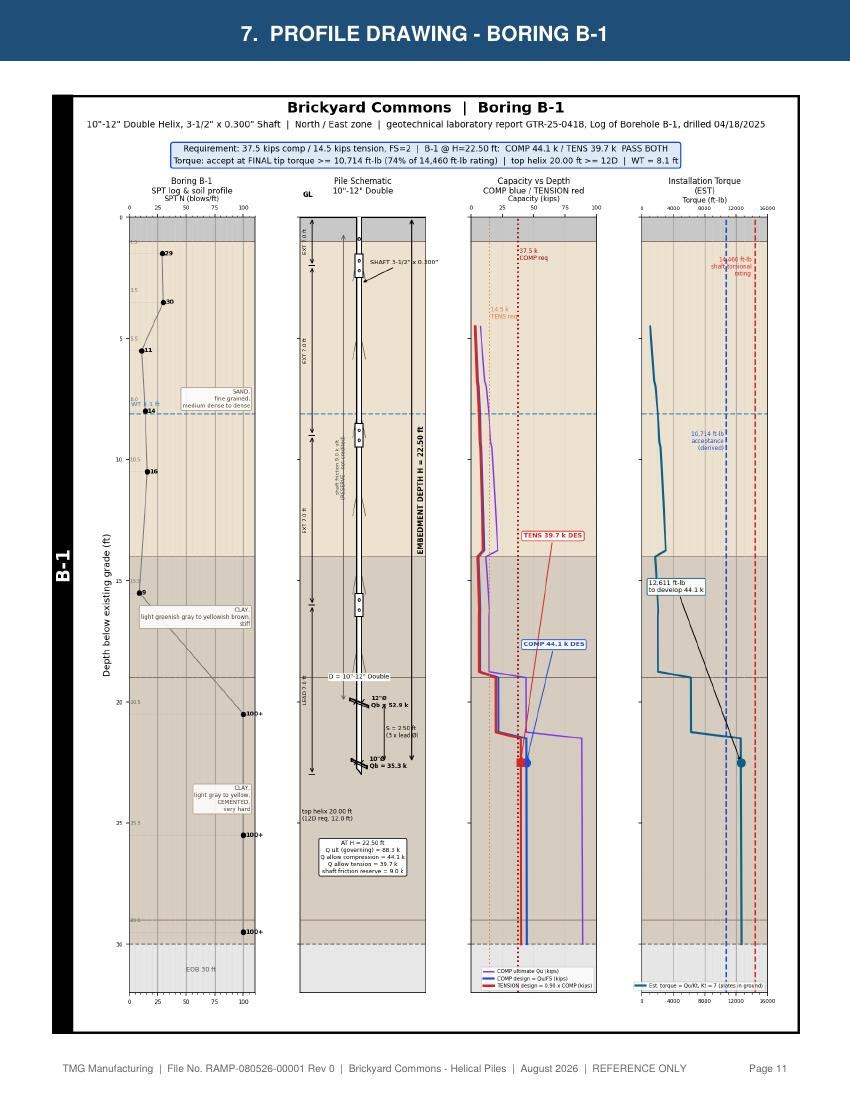
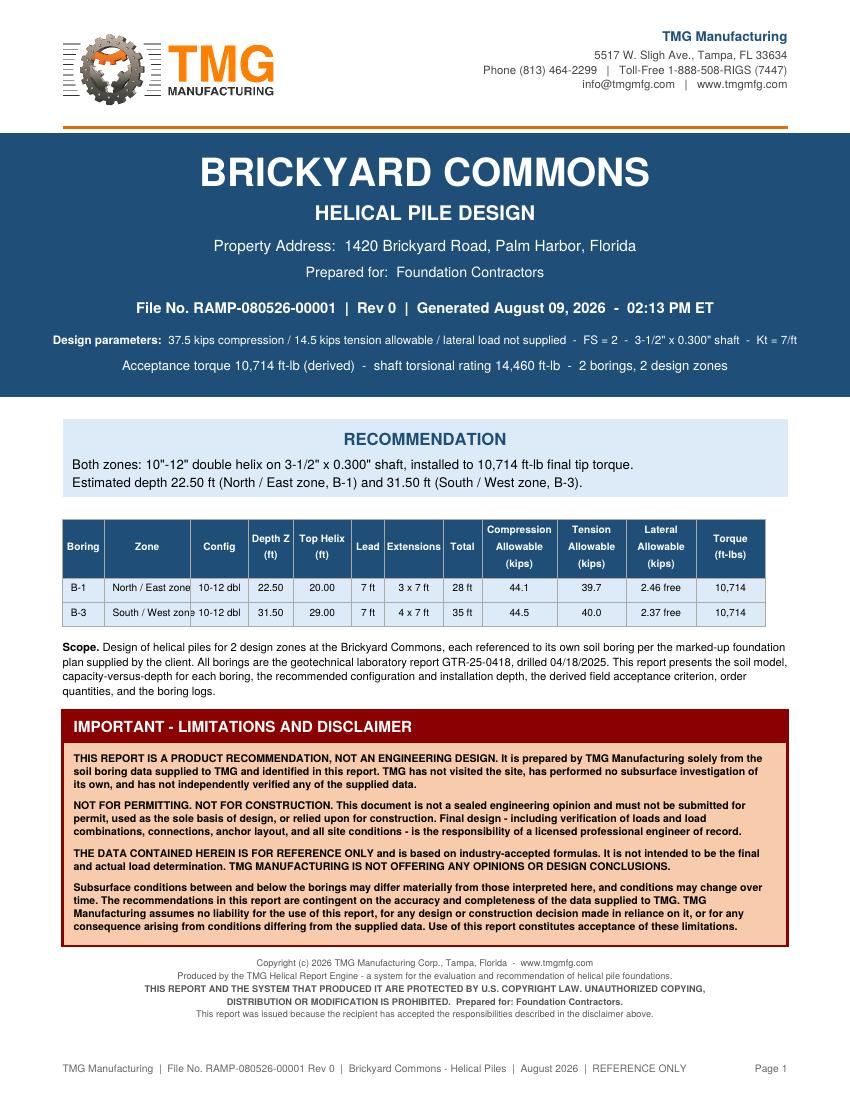
The Complete Helical Report from the CPT layer model. Loads are taken on the helical order form.
Liquefaction screen
Needs the design PGA and magnitude. Included in the seismic package.
Lab-data overlay, calibrated Nkt
Vane, triaxial or index results plotted against the cone estimates; the cone factor calibrated to your site.
Same-day turnaround
Standard delivery is 24 hours.
Sample reports
What you receive
Two real deliverables from a five-sounding site in Curridabat, Costa Rica: the site report, and the soil report for sounding P-2. Scroll each window.
These sample reports assume a water table at the ground surface because the client did not supply one — the conservative bound, flagged in the report exactly as it would be on your order.
The Complete CPT Site Report · 21 pages
The Complete CPT Soil Report, sounding P-2 · 23 pages
Disclaimer. Every RAMP report is a recommendation based on the data supplied by the customer. It is not a sealed design. Review and acceptance by the engineer of record, a licensed professional engineer, is required before use in construction.
COMING SOON — this service is in development. Ordering opens at launch.
COMING SOON
CPT Testing Module
CPT Report Request
Upload the raw file from any cone rig, or the CPT report you already have. Choose what you need and we produce The Complete CPT Soil Report for every sounding, with a site report and 3D model when you have more than one. Fields marked * must be answered before we can start.
COMING SOON — i-SPT Data Logging is in development. Pricing and sign-up open at launch.
COMING SOON
i-SPT Data Logging · Coming soon
Log the SPT at the rig.
Deliver the boring log before you leave the site.
i-SPT is a field app for drillers: record every Standard Penetration Test blow count on a phone or tablet as the hammer falls — offline if the site has no signal — and hand the office a finished boring log the same day.
Pricing and plans will be published here at launch.
What it does
- Tap-to-count blow intervals with haptic feedback; N-values computed as you go, automatic refusal at 50
- Soil log per point with USCS classification, water table, recovery, notes and photos
- N-value graph with test-type column and depth callouts
- Exports PDF, Excel (photos in the cells) and AGS4 for gINT, LogPlot and HoleBASE
- Office Mode: manager dashboard across all borings, grid editor, review-and-lock with a full revision history
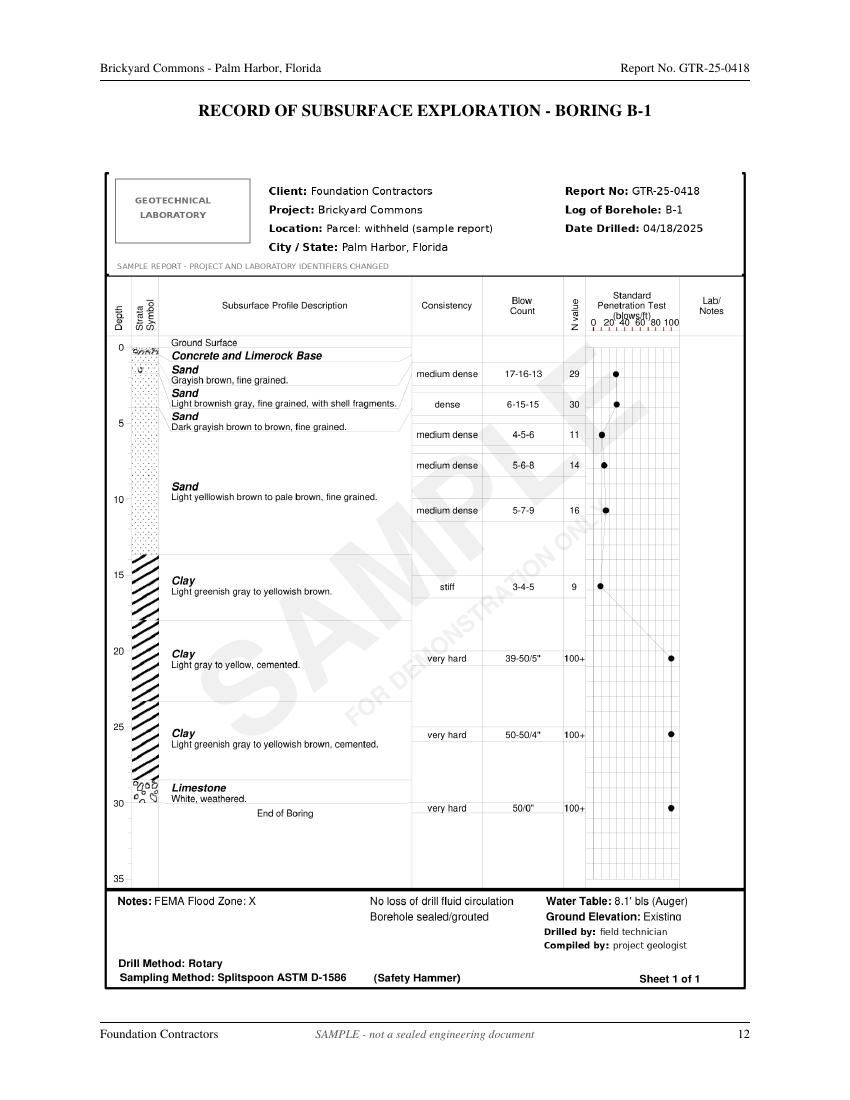
- Works fully offline in the field; the boring record feeds a RAMP Helical Pile Design Report
At a glance
| Runs on | iPhone, Android, tablet · any browser, no install |
| Standards | ASTM D1586, EN ISO 22476-3, AS, IS, JIS and national variants (9) |
| Languages | EN, ES, FR, IT, DE, ZH, HI (8 interface languages) |
| Output | PDF · Excel · AGS4 · portable .ispt record |
| Plans | to be announced |
How It Works
From Boring Log To Buildable Design In Twelve Steps
Watch the RAMP Engine take a real set of field data all the way through to a sealed helical pile design report. Every panel below is a stage the engine actually runs — nothing is skipped and nothing is templated.
The full run takes about 50 seconds. Use the bar at the bottom of the film to pause or restart it.
The Twelve Steps
The same sequence, in writing, for when you would rather read it than watch it.
1Import & UploadSPT reports, boring logs, lab results, drawings and site photos go in first.
2Data ExtractionN-values, stratigraphy, groundwater, unit weights, strength parameters and loads are pulled out.
3RAMP Engine AnalysisCapacity, buckling, torque, lateral and settlement run together against the factor of safety.
43D Soil Model BuiltThe subsurface is rebuilt as a layered model with the applied load and trial embedment.
5Engineering CalculationsCompression, tension and lateral demands are checked against every design criterion.
6Scenarios & OptimizationDepths are tested side by side and the governing one is chosen, not guessed.
7Pile Layout & PlanPiles are laid out on the plan with type, spacing and load direction called out.
8Data & Results CompilingResults compile into report sections — summary, soil profile, capacities, installation criteria.
9SPT Boring LogsYour original boring logs travel with the design, plotted against depth, bound into the appendix.
10Finalizing DocumentFormatting, cross-referencing and quality control run before final review.
11Report GeneratedThe Complete Helical Report is generated — every section, table and drawing.
12Complete & Ready29 sections, 59 gate checks, 3 free modifications. Report, drawings and calculations, ready.
Three Free Modifications On Every Report
Design is a conversation, and the first answer isn't always the one you build. If your report comes
back with a different helical size or configuration, ask — the RAMP Engine re-runs the full analysis and
we reissue the complete report at No Charge! Same for a different wall thickness, helix
configuration, coating, manufacturer or load requirement. Two of those are included with every
project, requested straight from your dashboard. We are not going to nickel-and-dime you for
asking a reasonable engineering question.
Your Project. Your Equipment. Your Design.
Your preferred manufacturer, the pipe your crew stocks, the torque your drive head can actually deliver — saved once in your account and applied to every report we run for you.